





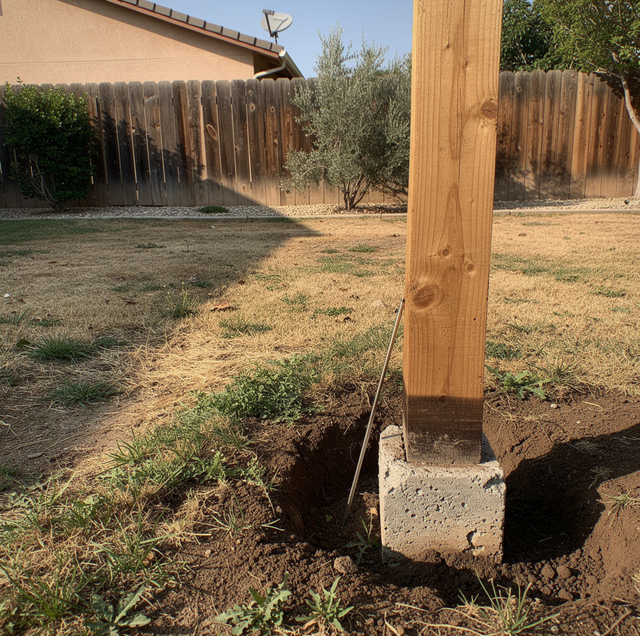
A wood fence post stays upright because two factors work together: its depth and the mass of soil or concrete gripping its buried end. Set deep enough and backfilled right, that buried section resists the force a tall panel puts on it every time wind pushes against the face or the ground around it moves. Pull either piece away, through a shallow hole, soil that has washed loose, or wood that has started to break down at the surface, and the post loses its anchor point. The panel above keeps pushing on it the same amount it always did; the post just has less holding it back, so it tips.
The table below separates the three outcomes a leaning post can end in, since the right fix depends on what is failing underground, not on how far the top of the post has drifted.
| Outcome | What is still sound | What has to happen |
|---|---|---|
| Reset in place | Footing and post are solid; only the surrounding soil shifted | Dig around the footing, replumb it, repack or add fresh concrete |
| Replace one post | Wood has rotted at the base, or the footing itself cracked | Pull the old post and footing, set a new post and footing in the same spot |
| Rebuild a section | Several posts in a run show the same failure, or rails and pickets have pulled apart at the joints from repeated movement | Remove and reset a run of posts together so the whole section sits plumb and square again |
What Pushes a Post Out of Plumb
A post with roughly a third of its total length below grade has enough soil bearing against its sides to resist ordinary wind load on its panel. Several things erode that margin. A hole dug shallow to begin with never had the bearing surface the ratio assumes, so it was marginal from the first day. Wood that sits right at the soil line, where both moisture and air reach it, breaks down faster there than wood fully buried below it or wood that stays dry above grade; decay needs both oxygen and moisture to proceed, and that band at the surface has both in supply. Once the fibers there soften, the post has a hinge point, even if the footing below it is intact.
Soil movement is a separate mechanism. Clay-heavy ground swells as it takes on water and shrinks as it dries, and that cycle flexes against anything buried in it, including a concrete footing. Over repeated wet-dry cycles, the footing can tilt slightly with each swing and not fully return to plumb, so the lean accumulates one season at a time. On sandy ground that drains fast, that swing hardly registers, and a leaning post there sends the search back to the hole, the wood and the wind.
Wind is the third mechanism, and it works on the panel, not directly on the post. A solid panel presents its full face to the wind, so the post anchoring it absorbs that entire load at the top of a long lever arm. Fencing built with gaps between pickets or boards lets a share of that air pass through rather than loading the whole face, so an open-style fence of the same height exerts less lateral force on its posts than a solid one does.
Check plumb on two faces of the post, not one; a post can lean away from the fence line and along it at the same time, and a single reading on one face can miss the second angle.
Reading the Lean: One Post, a Few, or the Whole Run
The pattern across the fence line narrows the cause before any digging starts. A single post out of plumb while its neighbors stand straight points toward something local to that post: rot at its base, a hole that was dug shallow or narrow when the fence went in, or a footing that cracked on its own. A run of several posts leaning the same direction, by a similar amount, fits soil movement along the line, a prevailing wind loading solid panels, or posts all set too shallow when the fence went in; the probe and a look at hole depth sort those out. Posts leaning in different directions along the same run point to causes local to each post: rot at one and a short hole or a cracked footing at another.
The angle itself matters less than whether it is getting worse. A post that has sat at a slight, stable lean for years without changing is a different problem than one that has visibly moved in the last few months; the first can wait for a planned reset, the second is actively losing its anchorage and is worth addressing before a gate, panel, or neighboring post takes on the added load.
Checking the Post for Rot at the Ground Line
Rot at the base is confirmed with a probe, not a visual check from standing height. Push an awl, a screwdriver, or a thin metal rod into the wood right where it meets the soil and again an inch or two below that line. Sound wood resists the point and holds its shape. Wood that has started to break down gives way easily, feels spongy, or crumbles into dark, soft pieces rather than splintering. Because decay starts at the surface and works inward, a post can look solid from the outside while the core at the ground line has already gone soft, so probing into the wood tells you more than scraping or pressing on the face.
A post that probes sound everywhere, including at and just below grade, points to soil movement, a shallow hole or a cracked footing, and that moves it toward the reset row of the table.
Have the utility-locating service mark gas, electric and water service lines before any footing comes out or a new hole goes in. Private irrigation and lighting lines are not on its map; a crew probes for those by hand near the post.
When a Post Can Be Reset in Place
A post qualifies for a reset when the wood probes sound and the existing footing remains a solid, uncracked mass roughly the size it should be. The work involves digging out the soil around the footing enough to free it, tipping or walking the footing and post back to plumb, then repacking the soil tightly or adding fresh concrete around the base to lock the new position in. If the old footing is sound and the right size for the post, it does not always need to be removed; it can be left in place, slightly broken at the top if needed to true up the angle, and surrounded with fresh concrete rather than removed and replaced whole.
Fast-setting post mixes firm up within about half an hour, and on some of them the post can take a rehung panel or gate after about four hours; standard mixes need about a day. Check the bag for the mix in hand, and keep the load off the post until that time has passed, since an early load can be pushed back out of plumb before the concrete grips it.
When a Post Needs to Be Replaced, Not Reset
A post goes from reset to replace when the probe finds soft wood at or below the ground line, when the footing itself has cracked or broken into pieces rather than just shifted, or when the hole it originally sat in turns out to be too shallow or too narrow to hold a post of that height properly even once it is replumbed. In those cases, resetting the existing post and footing just repositions a part that is already failing; the post or footing comes out, and a new post goes into a hole dug to the depth the post's height calls for.
If a single post needs replacing on a fence panel that is otherwise attached to sound, plumb posts on either side, that panel can stay fastened to its neighbors while the one post is freed, pulled, and reset with a new footing, rather than taking down the whole section.
Deciding Between a Partial Rebuild and a Full Fence Rebuild
A rebuild becomes the better call once more than one post in a run shows the same underlying failure, since resetting posts one at a time against neighbors that are already pulling in a different direction tends to re-stress the rails and pickets and shorten the life of the repair. It is also the better call when the panels themselves have pulled loose at the rail joints or split from repeated racking, because a straight post attached to a twisted panel will not hold a clean line for long. A partial rebuild resets a defined run of posts, squares the panels back to them, and leaves the rest of the fence alone; a full rebuild makes sense only where the same failure appears across most of the fence line rather than in one section.
One leaning post does not condemn the whole fence or force a tear-out of the run. The direction and pattern of the lean, what a probe finds at the ground line, and the condition of the existing footing between them point toward one of resetting, replacing, or rebuilding a section, and getting that call right the first time is what keeps the fix from needing to be redone next season.
Frequently Asked Questions
Wet clay can swell enough to push a plumb post slightly out of true on its own, then settle back toward plumb within a few days as the soil dries out again. A reading taken right after rain can overstate the lean, so check again after a few dry days to let the ground firm back up before deciding a post needs work.
No. A footing poured wider at the top than at the bottom gives swelling clay a lip to push up on, so the whole block can lift and tip while staying in one piece. A straight-sided footing, or one slightly wider at the bottom, gives the clay less to grab.
A temporary brace, a diagonal board staked into the ground and screwed to the post, holds a post from leaning further for a short stretch so a panel does not keep working loose while a proper fix is scheduled. It does not restore the footing or the soil bearing against it, so it is not meant to carry a post through an entire season.
Yes. Treated lumber is graded by use, and a post set in soil or concrete needs wood rated for ground contact. Lumber rated only for above-ground use carries less preservative and decays at the soil line sooner. The rating is printed on the tag stapled to the end of each piece.
The same spot can be reused once the old footing is removed in its entirety, with fresh concrete around the new post. Where the rotted stub of the old post is still locked in its concrete, the new post goes a few inches to one side in a footing of its own, with the rails trimmed or blocked to meet it, since a hole cored through old concrete is hard to keep plumb and full depth.
Only partly. A finish slows water entering the face above grade, but the buried section and the end grain at the bottom take in moisture from the soil, whatever the face is coated with. Shaping the concrete or soil collar so water runs away from the post at grade does more at that line.
Get a free, written assessment of what is failing at your fence line — before you decide between a reset, a post swap, or a full section rebuild. Specialty Landscape Inc. serves Fresno and the Central Valley. Licensed C-27 Contractor, CSLB #1058363. Call (559) 905-2273.

