





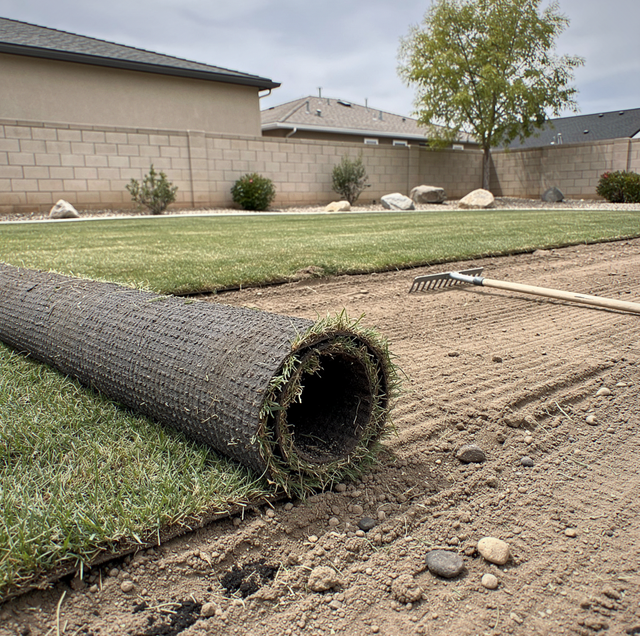
Choosing between artificial turf and sod rarely comes down to which one looks greener in a sales photo. Three things decide it: how much direct sun the yard gets, who and what uses the space (bare knees on the ground, a dog that treats the yard as a bathroom, a weekend game that chews up one corner), and how much ongoing water and mowing attention the household wants to keep up with. Each surface answers those three questions differently because the two are built from the ground up in opposite directions. Sod is a living root system that needs soil, light, and a steady water cycle to stay green. Turf is a manufactured surface with no roots at all, set on a compacted base and held together by backing, stitching and infill. Once you see what's underneath each one, the right call for a specific yard becomes a lot clearer.
The table below shows how the two surfaces compare across the factors that influence the choice: water, heat, shade, pets, and upkeep.
| Factor | Artificial turf | Sod |
|---|---|---|
| Water | No weekly cycle once infill settles; occasional rinsing only | Needs a consistent watering cycle to keep the root zone alive |
| Surface heat | Can climb well above air temperature in direct sun | Stays close to air temperature through transpiration |
| Shade | Color and density do not depend on light | Thins and can die out without enough daily light |
| Pets | Needs infill and drainage built for waste and odor | Absorbs waste, but concentrated urine burns brown spots, and heavy traffic wears paths bare |
| Upkeep | No mowing; periodic brushing and infill maintenance | Regular mowing, aeration and fertilization |
The Water Difference Between a Root Zone and a Built Surface
A sod lawn pulls water up through a root zone a few inches below the surface, and that root zone has to stay consistently moist, or the grass goes dormant and browns. That means an irrigation system, heads or drip emitters, a controller running cycles timed to the season, running on a schedule the household has to keep adjusting as temperatures change through the year. Turf has no root zone to keep alive. Once the backing, infill and compacted base beneath it are in place, it sheds rain and hose water straight through drainage perforations built into the backing, and it does not run on any watering schedule at all. The only water it uses on an ongoing basis is for rinsing off dust, pollen, or waste residue that rain alone will not clear.
Household water priorities factor into the decision too. Where cutting outdoor water use carries real weight for a household, removing a lawn's weekly watering cycle entirely can tip the choice toward turf. Where that pressure is light, a well-irrigated sod lawn remains a reasonable fit, with no extra watering changes needed beyond what the rest of the yard already runs.
What Each Surface Needs Underneath
Sod needs the native soil loosened a few inches down, amended with compost or another organic material, and graded so water sheds away from the house before the rolls go down. Turf needs close to the opposite approach: the native soil is excavated out, and a base of crushed-rock road base or similar aggregate is built up and compacted to a stable, even density, because any soft spot left under the surface becomes a low spot or a permanent footprint once the turf is down and can't be re-graded without pulling it back up. The turf itself is backed in polyurethane or latex and perforated across its whole surface so water passes straight through into the base below, then filled with infill, such as silica sand, an acrylic-coated sand, or crumb rubber, to hold the blades upright and give the surface some give underfoot.
Lawn removal cuts through the shallow layer where sprinkler pipe and lighting cable run. Those private lines are not marked by the public utility locate, so the crew flags heads and fixtures and traces the lines before the cutter goes in.
Surface Heat in Direct Sun
Turf has no transpiration, the process a living plant uses to pull water up and release it as vapor, which is what keeps a sod lawn's surface close to the surrounding air temperature even in full sun. Without that cooling process, a turf surface in direct midday sun can climb well above the air temperature, hot enough on a summer afternoon to be uncomfortable or even painful on bare feet or paw pads. A sod lawn with that same sun exposure stays close to whatever the air temperature is because the grass is actively releasing moisture as long as it's green. A yard with ample unobstructed midday sun will feel the heat difference most, while partially shaded turf runs noticeably cooler than a strip with no shade at all.
Ask which infill a turf quote specifies. A light-colored coated sand that holds a little water from a rinse runs cooler in full sun than dark rubber infill does, and the difference is most pronounced on a yard with no afternoon shade.
Shade Changes the Outlook for Both
Deep, consistent shade works against sod differently than it does against turf. Grass needs a number of hours of light each day to photosynthesize and build the root reserves it draws on between waterings, so under mature trees, a low canopy, or a shaded north-facing side of the house, sod thins out and bare soil starts to show through within a season. Turf's color and density do not depend on light at all, so a run of shade that would defeat a sod lawn does nothing to change how the turf looks or holds up. That does not make turf the automatic answer for every shaded yard: a heavily shaded bed can still favor ground cover or mulch over either option, depending on what else is planted nearby and how much root competition is already in the soil.
Pets and Traffic Wear Each Surface Differently
A dog tends to use the same few spots in a yard as a bathroom, and turf's infill and drainage have to handle that concentration without holding odor at the surface. An infill built for odor control, along with enough perforation in the backing to let liquid pass through rather than pool, keeps ammonia smell from building up between rinses, and the surface still needs an occasional hose-down to clear residue that rain alone won't rinse away. Sod handles pet waste by letting it soak into the soil, where soil microbes break it down over time, though urine concentrated in one spot burns a brown patch, and a path a dog patrols along a fence line, or a gate a dog uses several times a day, wears the grass down to bare dirt faster than mowing and fertilizing alone can keep up with.
Kids and Play Areas
Either surface can work along a general play strip, but neither alone cushions a fall from a swing or a climbing structure. Under play equipment, turf goes down over a foam shock pad sized for the equipment's fall height. Turf gives a play area consistent footing regardless of recent rain, no mud, no dust, and no uneven ground from a worn patch that never fully grew back in. Sod gives a soft, natural surface too, but a spot that gets the same repeated impact, under a swing, at the base of a slide, wears down to bare dirt, and reseeding that patch has to compete with daily foot traffic that keeps disturbing new grass before its roots take hold.
Upkeep Through the Seasons
A sod lawn asks for recurring attention through the year: mowing at a height suited to the grass variety and the season, aerating compacted soil so water and air reach the root zone, overseeding thin spots before they turn to bare dirt, and adjusting watering as the weather and mowing schedule both shift. Turf skips all of that, but it is not maintenance-free. Infill settles and compacts over the years and needs to be topped off and brushed back upright so the blades don't mat down permanently, seams and perimeter edges need to stay secured so they don't lift at a corner, and leaves, pine needles, and other debris have to be cleared off the surface so they don't trap moisture and build up organic matter underneath.
Neither surface is the better lawn for every yard on its own merits. A shaded yard with a dog that digs calls for a different build than a sunny front strip in a water-conscious household with no pets. Walking through how a specific yard gets used, hour by hour and season by season, points toward the surface built for those real conditions rather than the one that simply looks best in a photo on day one.
Frequently Asked Questions
Running a hose over turf for a few minutes drops the surface temperature for a short window afterward, which is worth doing before kids or pets use it during a stretch of hot, direct sun, but the surface climbs back up once it's dry again.
New sod needs about two to three weeks of steady watering for its roots to knit into the soil beneath before it can take regular foot traffic or a first mowing; mowing or walking on it earlier can tear up roots that haven't yet anchored.
St. Augustine and tall fescue keep a stand with a few hours of direct sun a day, while bermudagrass, the common sun-loving sod, thins out under almost any regular shade. Under a canopy dense enough to block direct sunlight all day, no sod variety can maintain a full lawn.
On sandy soil, the aggregate base under turf can be thinner because the native soil beneath it already drains well, but it still has to be compacted to the same density as it would be elsewhere, since an under-compacted base settles into footprints and low spots no matter what soil lies beneath it.
A shorter, denser pile with closer blade spacing holds its shape better under repeated impacts from a swing set or a play strip, while a taller pile gives a more natural lawn look but mats down faster in the same spot under that kind of concentrated, repeated use.
The seam where turf meets a sod section needs its own edge restraint, a metal or plastic strip set below the sod's root zone, so the sod's spreading roots don't creep underneath the turf's perimeter and lift it at the edge over time.
Walk your yard with us before you commit to either surface — we'll point out where shade, pets and traffic change the call for your specific layout. Specialty Landscape Inc. serves Fresno and the Central Valley. Licensed C-27 Contractor, CSLB #1058363. Call (559) 905-2273.

