





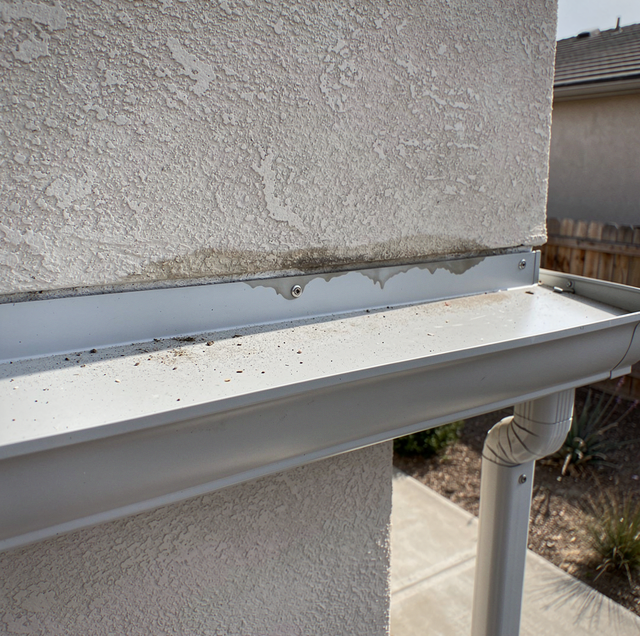
An attached patio cover hangs its back edge on your house. A ledger, which is a wood beam or aluminum header fastened through the siding or stucco into the wall framing, carries that edge. The roof panels run from the ledger to a front beam, and the gutter is set lower than the back, so rain travels away from the wall. A strip of metal flashing laps over the top of the ledger and tucks up behind the wall finish, so water running down the house passes over the joint and onto the panels. When every piece does its job, the wall stays dry. When you see drips along the ledger, a dark band on the stucco or a puddle against the house after rain, there are four places to look: the flashing, the gutters, the fasteners and the pitch. A fifth possibility is a wall that is wet with no leak at all.
How Water Is Supposed to Leave an Attached Cover
Every weather-tight joint on a house follows one rule: the upper layer overlaps the layer under it, so water running downhill always lands on the outside of the next piece. This is called shingle-lapping. At a patio cover, the order from the top down is the wall's water-resistive barrier (the building paper or wrap behind the stucco or siding), then the flashing tucked behind that barrier, then the ledger, then the cover panels resting on or hung from the ledger.
Solid aluminum panels interlock along their long edges, and those seams run downhill toward the front of the cover. The front beam carries a gutter, and a downspout directs water to a post. The whole path depends on fall. A solid aluminum cover needs at least 1/4 inch of drop for every foot it projects from the house. Over a 12-foot projection, that puts the front edge 3 inches lower than the back.
Check the Flashing Over the Ledger First
Flashing is the part that keeps wall runoff out of the ledger joint, so it is the first suspect when drips form in a line along the ledger's full length. Water that shows up evenly along the joint during a steady rain, with no wind, points to the flashing more than to any single fastener.
Flashing fails at a ledger in a handful of ways:
- Missing: The ledger was bolted to the wall and sealed with caulk, with no metal over it at all.
- Surface-applied: The flashing sits on the face of the stucco and is caulked along its top edge. Water that soaks into the stucco or runs down behind it exits under the flashing, not over it.
- Short at the ends: The flashing stops before the ends of the ledger, so water running along the joint turns the corner and goes into the wall.
- Reverse-lapped: On lap siding, the flashing was slipped over the siding course above it, so that course drains behind the metal.
Fixing this properly means getting the flashing behind the water-resistive barrier. On siding, that involves lifting or removing the course over the ledger. On stucco, it means cutting a narrow groove or removing a strip of the finish, setting the flashing or a counterflashing into it, and patching. A new bead of sealant along the top edge of surface-mounted flashing does not change where the water inside the wall goes.
Gutter Overflow and Runoff From the House Roof
The gutter on a patio cover is sized for the water that falls on the cover. It is not built to carry the runoff from the house roof as well. If your house eave has no gutter, or its gutter overflows, the entire roof plane above the cover dumps onto the first foot or two of panels next to the ledger. That sheet of water piles up against the back edge, pushes under the flashing, and finds every gap in the joint.
Overflow has a signature: the leak shows up first in heavy rain, fades as the rain lightens, and is worst under a valley where the house roof concentrates its flow.
The cover's own gutter can cause the same backup. Leaves, seed pods, and roof grit settle in the front gutter, and a blocked downspout outlet fills the trough. Once the front gutter is full, water stays on the panels longer, and on a cover with marginal fall it can creep back along the seams toward the house.
Fasteners Driven Through the Wall and Roof Line
Every lag screw that holds a ledger to the house passes through the siding or stucco, the water-resistive barrier, and the sheathing before it bites into framing. Each one is a hole. A sound installation seals each penetration behind the ledger, and the flashing keeps standing water off the screw heads. When that sealing is skipped or has aged out, water runs down the wall, meets the lag and follows its threads inward.
A fastener leak has a pattern. The drips land at points spaced along the ledger at the framing interval, 16 or 24 inches apart, and a rust streak or stain runs down from each lag head. Between those points, the joint stays dry.
Some covers attach higher than the wall. Where the eave is too low for a wall-mounted ledger, the cover may be screwed to the fascia board and through the house's drip edge, or carried on riser brackets screwed down through the roofing so the cover clears the eave. Each bracket needs its own flashing worked under the shingles or tile. A missing or lifted bracket flashing lets water into the roof deck, and it can show up inside the house on the ceiling near the exterior wall, not on the patio.
The cover's ledger, flashing, and gutter belong to the patio cover. A leak in the house roof itself, including roofing that has to be relaid around a bracket, is a job for a roofer.
If water drips from a ceiling fan, a recessed light or a junction box near the ledger, switch that circuit off at the breaker and leave it off. Have an electrician open and dry the box before anyone restores power.
A Cover That Pitches Back Toward the House
A cover that once drained well can start to tilt the wrong way. Front posts set on an old slab or a shallow pad can settle, dropping the front beam until the fall flattens out. A ledger that has started to pull away from the wall can sag at the house end, and a long front beam can deflect at mid-span. Any of these leaves low spots where water collects against the house.
You can check the slope without climbing on anything. After a rain, look along the underside of the panels for a line of drips or a sheen near the ledger, and look at the cover gutter to see whether water sits at one end. From the ground, a long level, held against a post, tells you whether the post is still plumb. A post leaning out at the top, a gap opening between the ledger and the wall, cracks in the stucco radiating from the lag heads, or panels that no longer line up at their seams are each signs the structure may have moved.
Those are structural warning signs. Sealant does not stop a ledger that is pulling loose, so the attachment and the posts get corrected first and the leak repair comes after.
Why a Bead of Caulk Keeps Failing
A sealant bead sits on the surface of a joint that moves. The aluminum cover and the wood-framed house expand and contract at different rates, and wind lifts and drops the panels. Each cycle stretches and squeezes the bead until it tears loose along one edge. Sunlight breaks down the exposed surface at the same time.
Stucco makes adhesion harder. Its porous, dusty surface lets a bead bond to loose grit, and a hairline gap opens behind it where you cannot see it.
The larger problem is direction. Caulk can only block water at the joint face. It does nothing about water already traveling inside the stucco or behind the siding, and a bead run along the bottom edge of a flashing can trap that water against the ledger and the framing. Sealant serves as a backup at fastener heads and at the ends of lapped flashing. It cannot replace the lap.
Wet Wall or Real Leak? Run a Hose Test
Stucco absorbs water. On a two-story house, or a house with no gutter over the cover, rain hits the cover and splashes onto the wall, soaks in, and wicks downward. The result is a dark, damp patch on the stucco under the ledger after a storm, with no drip from the joint itself. This is called wet wall. It looks like a leak, and it can coexist with one, so test before you decide.
A hose test isolates the source. Pick a dry day and have a helper stand under the cover watching the ledger. Work from the lowest point up, one zone at a time, running water gently for several minutes before moving on:
- The front gutter and downspout.
- The panels next to the ledger, sprayed downhill the way rain falls.
- The flashing and the wall just over it.
- The house eave or roof edge over the cover.
The first zone that produces water under the cover is your source. Spray in the direction rain travels, never upward into a seam, because a hose can force water through a lap that sheds rain without trouble.
Mark each zone with painter's tape before you start and write down how long each ran before a drip appeared. Photos of the drip location with the zone number give whoever repairs the cover a clear map.
A patio cover leak at the wall is a sequencing problem: some layer is out of order, some channel is full, or the slope has changed. Find which one first, because the repair for each is different, and sealant over the symptom leaves the cause in place.
Frequently Asked Questions
Polyurethane and acrylic sealants will not bond to cured silicone, and even fresh silicone adheres poorly to old silicone. If the old bead is silicone, it has to be cut out completely and the surface cleaned of its residue before any new sealant goes on, or the new bead peels off the old one. Even then, sealant only buys time if the flashing is wrong.
Aluminum grows about 0.0000128 of its length for every degree Fahrenheit. A 20-foot aluminum gutter or ledger that swings 80 degrees between a cold morning and a hot afternoon changes length by roughly 1/4 inch. Sealants are rated to stretch and compress only a fixed share of the joint width, commonly 25 or 50 percent, so a thin bead across a working joint fails fast.
Yes, if it runs long enough. Wood framing that stays above about 20 percent moisture content for extended periods can begin to decay. Warning signs on the outside include a white, powdery crust on the stucco (salts left as water evaporates), paint that bubbles or peels on the wall, and stucco that sounds hollow when tapped.
Yes. An open lattice cover is built to filter light, and rain falls straight through it, so drips under the lattice are expected. The ledger is still bolted through the wall, though, and water running down the house can follow those lag screws into the framing, so the ledger needs the same flashing as a solid cover.
It sits right at the edge where house runoff falls, so it has less margin. A fascia-mounted cover drains better with more fall than the minimum, around 1/2 inch per foot, plus extra downspouts or a deeper gutter at the front. Even with those steps, a fascia joint under an eave with no drip edge metal can take water in a hard, windy rain.
No. Aluminum cover panels are not built to support a person's weight, and leaning a ladder against the panels or the front gutter can dent or crease them, creating new low spots. Set the ladder on the ground at the end of the cover and clear the gutter from there, working along it in short sections.
Schedule a free on-site estimate for your patio cover — have the ledger flashing, gutter, and pitch checked before water reaches the wall framing. Specialty Landscape Inc. serves Fresno and the Central Valley. Licensed C-27 Contractor, CSLB #1058363. Call (559) 905-2273.

