





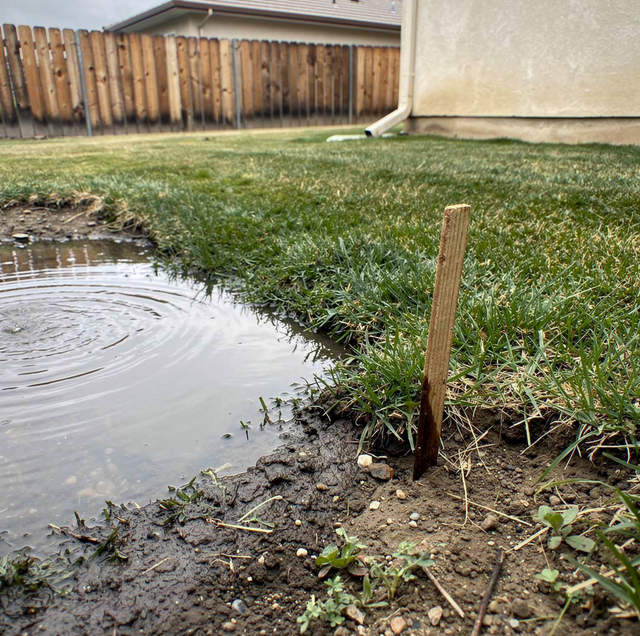
Three days after the last storm moved through, the low corner of the backyard is still holding a flat sheet of water, the grass underneath has gone soft and gray, and the ground squelches on every step nearby. Everywhere else on the property dried out within a day, so it is easy to wonder whether this one corner is just unlucky or pointing to something worth fixing before the next storm fills it back in.
Water that lingers for days comes down to one of three conditions, working alone or stacked on top of each other: soil too dense to soak water in fast enough, ground flat enough that gravity cannot pull water anywhere else, or a downspout or slope concentrating more water into one spot than that spot can ever absorb. Reading which of these is happening on a given property decides whether the fix is a shovel and some fill dirt or a buried pipe carrying water somewhere else entirely. A leaking sprinkler valve or lateral line can keep the same spot wet between storms too, and that patch stays soggy through a dry week, when a rain-fed puddle would have shrunk.
Reading Where the Water Sits and How Long It Lasts
Before deciding on a fix, it helps to look at the shape and timing of the puddle itself, not just the fact that one exists. A water line confined to a single dish-shaped low spot points to a localized grade problem there. A thin sheet spread across a wide, flat section of lawn suggests a whole-area soil or slope issue rather than a single bad dip. Water that shows up only along one side of the house, in a band running out from a downspout or under a roofline, points to concentrated discharge from the roof, or to ground that slopes back toward the wall there, more than to a drainage problem with the yard as a whole.
Timing matters as much as shape. A day or two of standing water after a hard, soaking storm is not unusual on denser ground, and it is not automatically a sign anything needs to change. The pattern worth acting on is water still sitting with no new rain falling and no real change from one day to the next, especially if the same spot does it after every storm rather than only the heaviest one of the year.
Walk the yard with a flashlight the morning after a storm and mark every spot still holding water with a stake; doing this after two or three different rains shows whether the same low spots repeat or move.
Why Heavy Clay and Hardpan Keep Water From Draining Away
Clay particles pack together far more tightly than sand or loam, leaving only narrow spaces between them for water to pass through, so water moves down through clay many times more slowly than through looser ground. A compacted hardpan layer sitting a foot or two below the surface stops that water outright: rain soaks in until it meets that layer, then it has nowhere to go but sideways or up, so a yard can hold standing water even where the surface soil looks perfectly normal.
Ground like this also swells as it takes on moisture, which further narrows the already-narrow pore spaces the longer a storm runs, so the second day of a multi-day rain can drain more slowly than the first. A property with sandier pockets nearby can shed the same rainfall within a few hours, because the particles are larger and the gaps between them stay open even when wet. Neither soil type is a flaw on its own; the difference is simply how much time each one needs to move the same volume of water through the ground.
How Flat, Low Ground Changes the Fix
For water to move across the surface, it needs a continuous downhill path to follow. On ground with little or no built-in fall, water settles wherever the grade dips, even by an inch, and that dip can be invisible to the eye on a dry day. A property with real slope sheds the same rain toward the street or a side yard without any help, because gravity carries it there on its own; flat ground has no such advantage and needs that fall built in deliberately.
Close to the house, the ground should drop about six inches over the first ten feet leading away from a wall, so water moves away from the foundation rather than pooling against it. Where that fall is missing, water backs up right where the walls meet the ground, which is also where the longest-lasting puddles tend to show up.
When Downspouts Are Adding to the Problem
A downspout emptying directly onto the ground at the slab or foundation corner takes the runoff from an entire roof and concentrates it into one small point, so even soil that handles ordinary rainfall without trouble gets far more water at that single spot than anywhere else on the property. Without an extension or a buried line carrying that water further out, the ground right there saturates first and stays wet longest after everything else has dried.
A puddle that traces back to a downspout has a clear signature: it starts right at the end of the spout or splash block and fades out a few feet away, rather than spreading evenly across the yard. That pattern separates a downspout problem, which moving the discharge point farther from the house can solve, from a soil or grading problem that affects a much larger area.
Topsoil, Regrading, or a Drain: Matching the Fix to the Cause
Dumping a few bags of topsoil into the puddle is not the fix for ground that will not drain. Without somewhere for that water to go, new fill sitting in the low spot just becomes another layer resting on the same clay, and it can hold water even more than the original grass did, since loosely placed fill packs down unevenly and often creates a fresh shallow bowl of its own.
Which approach solves the problem depends on what the mapping and the soil show. A single, clearly defined low spot surrounded by ground that already has fall available can often be corrected by tying new fill into the surrounding grade, feathered out gradually rather than piled straight into the hole, so the whole area slopes consistently toward wherever water is supposed to go. Ground that is flat across a wide area, with no low spot to blame, usually needs a shallow surface channel shaped to carry water toward a safe discharge point, since there is no existing high-to-low path to work with. Ground where neither of those options has anywhere for the water to go, because the clay layer traps water no matter how the surface is shaped, is the case that calls for a buried drain line running the water out to a point where it can leave the property; a lot that sits lower than everything around it can need a sump pump to lift the collected water out.
Any trench deep enough to carry a drain line can cross a buried gas, power, or water line, so have the utility locate service and mark the yard before digging, and have the crew hand-dig wherever a trench crosses a painted mark.
Signs the Standing Water Is Becoming a Bigger Problem
Grass sitting in saturated soil loses access to oxygen at the root zone, which shows up as grass that yellows, then blackens, then dies in the exact shape of the puddle rather than across the whole lawn. A musty smell, a spongy feel underfoot weeks after the rain stopped, or fungal patches spreading from the wet area are signs the soil underneath is staying saturated well past the point a healthy yard would have dried out.
Repeated pooling within a few feet of the foundation deserves attention sooner rather than later, since soil that stays saturated against a wall for extended stretches, storm after storm, behaves differently under that wall than soil that dries out between rains. None of that means every puddle is an emergency. It means the ones that keep coming back to the same place after every storm are the ones worth tracing back to a cause instead of waiting it out.
Standing water that keeps coming back has a findable reason behind it, and the shape, timing, and location of the puddle narrow it down to the soil, the grade, or where the roof's water lands.
Frequently Asked Questions
Once a puddle passes about a week with no new rain, it matters beyond the lawn: in warm weather, mosquito eggs laid in standing water can reach the flying adult stage in roughly that span, so a puddle that outlasts a dry week can already be producing mosquitoes.
Fill dropped straight into the puddle itself rarely helps, because loose soil surrounded by undisturbed clay has nowhere to drain either; to change the grade, new fill goes down in thin layers, each one compacted before the next, and its finished surface is shaped to fall away from the house before any sod or seed goes back on.
A core aerator pulls plugs two to three inches deep, which can relieve compaction in the topsoil layer homeowners can reach with a rented machine, but it does nothing to a hardpan or dense clay layer sitting below that depth, so aerating alone will not change how a yard drains if the real barrier is further down.
A dry well only works by letting the surrounding soil soak up what drains into it over time, so in heavy clay, a buried dry well with no overflow outlet eventually fills up and backs up the same way any other hole in the ground would; it functions as part of a larger drainage system rather than as a stand-alone fix on dense soil.
A shallow depression in one specific spot often traces back to ground that was disturbed and backfilled at some point, an old utility trench, a filled-in low area, or construction debris left under a thin layer of soil, all of which settle unevenly over months and years and can create a dip that was not part of the original grade.
Clay soaked against one stretch of foundation storm after storm swells there and then shrinks as it dries, while the walls around it stay drier, so that stretch can move more than the rest. A crack that appears or widens after heavy rain is a reason to fix the water at that wall and to have the crack itself checked by a foundation specialist.
Have the yard's drainage read on-site before the next storm fills it back in — a walkthrough that traces where the water comes from and where it settles. Specialty Landscape Inc. serves Fresno and the Central Valley. Licensed C-27 Contractor, CSLB #1058363. Call (559) 905-2273.


