





Stamped Concrete vs Pavers: Which Patio Holds Up on Clay Soil?
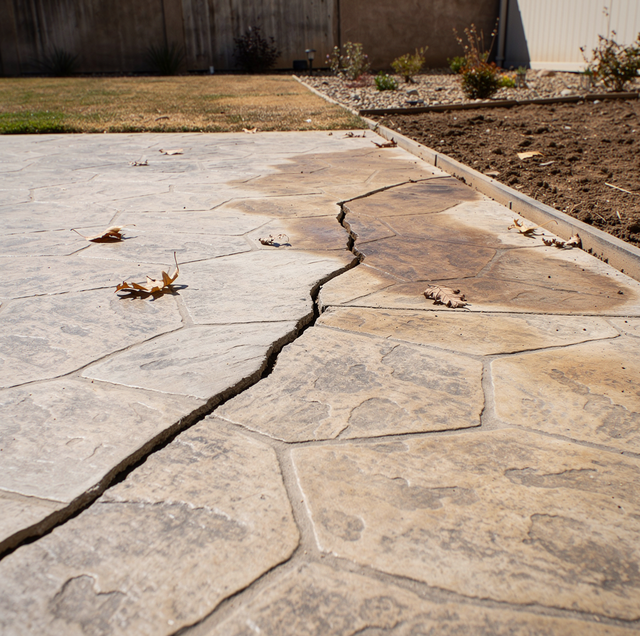
A crack running corner to corner across a stamped concrete patio looks like proof the whole job failed, and a paver that has settled an inch at one edge looks like evidence the crew rushed the base. Neither reading holds up once you know what each surface is. A concrete patio is a single continuous sheet, poured wet and cured into a single rigid piece, so when the ground beneath any part of it moves, the slab has nowhere to send that movement except into a crack somewhere along its length. A paver patio is built from individual units set in sand over a compacted base, each one free to shift, tilt, or settle on its own without pulling its neighbors with it. The slab fails as a whole; the paver surface fails one unit at a time. That difference, not how the color looks in a showroom sample, is what decides which surface holds up better under a given yard.
The table below lays out the core contrast before getting into why each behavior happens and what it means for repair.
| Stamped concrete | Pavers | |
|---|---|---|
| How it fails | A crack through the full slab thickness | One or a few units sink, tilt, or gap |
| Typical repair | Patch, resurface, or demo and repour a section | Pull the unit, rebuild the bedding, reset it |
| Color after years of sun | Fades or wears as a surface finish | Fades unit by unit at an even rate; a new replacement unit starts brighter and weathers in |
| Ongoing upkeep | Resealing on a cycle | Joint sand topping and occasional releveling |
A Rigid Sheet Cracks Where Pavers Flex and Settle
Concrete gets its strength from being one continuous pour, which is also its weak point on ground that moves. Once the mix cures, the slab is locked into the shape of the subgrade it was poured over. If a section of that subgrade swells, settles, or dries out and contracts after the fact, the slab has to absorb that change as rigid material, and rigid material under stress cracks rather than bends. A control joint is a cut line made while the slab is still young, giving stress a planned place to release, so the crack follows the cut instead of wandering across the middle of the patio. On clay, a crack that runs outside those cuts and keeps widening through wet and dry spells points to ground movement more than to the concrete itself.
Pavers sidestep that problem by never forming a continuous sheet in the first place. Each unit sits in its own bed of sand, interlocked with its neighbors through pattern and joint sand friction but not bonded to them. When the base under one paver settles or lifts, that paver moves with it while the units around it stay roughly in place, which is why a paver patio tends to show a dip, a tilted corner, or a widened joint rather than a crack running through solid material. The same ground movement that puts a visible crack in a slab can show up on a paver surface as nothing more than a slight unevenness you can feel underfoot before you can see it.
Walk a paver patio barefoot once a year and note any spot where a unit rocks or feels lower than its neighbors. Catching a single sunken paver early means resetting one unit instead of several once water starts pooling there.
Base Prep Decides Which Surface Survives Clay Movement
Both surfaces depend on what sits beneath them more than what sits on top, and that is where soil type does most of the work deciding which one holds up. Ground that runs heavy clay takes on water in the wet months and swells, then dries out and shrinks back down in the dry ones, and that cycle pushes and pulls on whatever sits above it. On that kind of ground, the aggregate base under a paver patio or a slab needs to be compacted in thin lifts to a depth well beyond what stable, well-draining soil requires, because a thin base over expansive clay transmits nearly all of that swelling and shrinking straight up into the surface. Where the ground is sandy instead, it drains quickly and barely swells, so the same base faces far less seasonal push, and the work shifts to compacting the loose sand so it does not settle beneath the base.
A slab poured over an undersized or poorly compacted base on clay will crack sooner and more often than one of the same thickness poured over a properly built base, because every swell-and-shrink cycle loads the same rigid sheet. Pavers are more forgiving of an imperfect base because individual units can absorb some settlement without the whole surface failing, but a paver base that is too shallow for clay will still show it through faster, more frequent releveling than the same patio would need on stable ground. On clay, base depth and compaction decide more of how either surface performs over the years than the choice of surface does.
Repairing a Crack Is Not the Same Job as Resetting a Paver
Once ground movement has already shown up on the surface, the repair paths diverge as much as the failure modes did. A hairline crack in stamped concrete that has not moved vertically can sometimes be filled and colored to blend into the surrounding texture, but a crack with any lip, where one side sits higher than the other, means the slab has shifted, and a surface patch will not hold the color match or the texture pattern for long. At that point, the realistic options are cutting out and repouring the affected section, which leaves a visible seam even with a careful color match, or living with the crack and sealing it to keep water from working into the subgrade through it and widening it further over time.
A displaced paver, by contrast, is a localized fix almost by design. Because each unit is a separate piece set in sand rather than bonded to the ones around it, a technician can remove the paver and the units immediately next to it, correct whatever happened in the bedding underneath, and reinstall the same units without touching the rest of the patio or introducing a new seam. That is the structural trade-off the two materials make from the start: concrete gives you one uniform surface with no joint lines to maintain, at the cost of a repair that is harder to hide once a crack opens. Pavers give you a surface built from repairable units, at the cost of joints that need periodic attention so they do not become the weak point instead.
If a repair means digging below the patio base, have the utility locate service mark buried lines first, and have an electrician trace any private line-voltage feed to a light, pump or outbuilding before anyone digs near it.
Color Method Changes How Fading and Wear Show Up Later
Both surfaces offer color, but the method behind the color affects how it ages, not just how it looks on day one. Stamped concrete can be colored by mixing pigment into the wet concrete before it is poured, which tints the slab evenly through its full thickness, or by applying color to the surface as the concrete sets, which produces a sharper, more varied finish but confines the color to a thin top layer. Pavers carry their color through the body of the unit during manufacturing, so a chip or a worn corner on a paver generally shows the same color underneath rather than a different base material.
How a surface wears over years of sun exposure follows from where that color sits. A surface-applied concrete finish can wear thin in the heaviest foot-traffic path across a patio well before the rest of the slab shows any fading, exposing a flatter, grayer patch under the pattern. A through-mixed concrete color fades more evenly across the whole surface because there is no thin surface layer to wear through, though it also tends to look less vivid than a surface-applied finish from the start. Paver color fades at roughly the same rate unit to unit under the same sun exposure, which is part of why a single reset paver rarely clashes visibly with the units around it even years after the original installation.
Keeping Each Surface Looking Right Takes Different Maintenance
Stamped concrete depends on its sealer to do more than add shine. The sealer is what keeps water, oil, and UV light from reaching the colored and textured surface directly, and once that sealer wears thin or fails, the surface underneath starts taking the damage the sealer was meant to absorb instead, including faster color loss and a surface that scuffs and stains more easily. Reapplying sealer on a regular schedule before it fully wears through protects the finish underneath; waiting until the surface looks dull or chalky means some of that damage has already occurred and cannot be fully reversed by resealing alone.
Paver maintenance runs along a different track entirely, centered on the joints rather than a surface coating. Sand between the units locks each paver against its neighbors and keeps the interlock that lets the whole surface flex together instead of shifting independently. That sand washes out gradually from rain, irrigation overspray, and foot traffic, and once enough of it is gone, individual pavers can rock, shift out of alignment, or let weeds root in the gaps. Topping off joint sand on a regular basis is the paver equivalent of resealing concrete: a small, recurring step that takes far less time and effort than the repair that follows if it gets skipped for too long.
Either surface, picked and built for the ground it is going on, can carry a patio through years of the same soil movement that would otherwise crack or unsettle it. The surface that lasts is the one whose base was built for how that specific ground behaves, not the one that looked best in a sample board.
Frequently Asked Questions
It can be. A glossy film-forming sealer over a smooth stamp texture turns slick under sprinkler overspray or pool splash, so a fine anti-skid grit can be mixed into the final sealer coat on walkways and poolside patios. Pavers keep the texture of the unit face, so the same problem shows up less on them.
Yes. A color hardener is a dry pigment troweled into the surface while the concrete is still plastic, which packs that top layer denser and more wear-resistant than the concrete underneath, while color mixed into the whole batch is uniform through the slab but does not get that same surface-densifying step.
Polymeric sand needs about 24 to 48 hours without rain or heavy watering after installation, depending on the product, so the binder in the sand can set up properly in the joints. Watering it too soon can wash the binder out before it hardens, leaving the joint loose again.
That haze is efflorescence, mineral salts carried to the surface by moisture moving up through the material and left behind once the water evaporates. It can appear on either stamped concrete or pavers in their first year or two and generally fades with normal weathering, though it can be scrubbed with a mild acidic cleaner if it bothers you sooner.
A woven geotextile laid on the clay before the gravel goes down keeps wet clay from pumping up into the base rock as the patio is walked and loaded. Without it, fines from the clay work into the gravel from the bottom and the firm base turns soft.
Not exactly. A patch cast today starts a different shade from a slab that has weathered for years. One way to narrow the gap is to apply a tinted sealer or a thin stain over the whole patio after the repair, so the patch and the old surface sit under the same coat of color.
Ask for a soil and base check before choosing between a slab and pavers — the ground under the patio decides how deep the base has to go. Specialty Landscape Inc. serves Fresno and the Central Valley. Licensed C-27 Contractor, CSLB #1058363. Call (559) 905-2273.


