





Prefab vs. Built-In BBQ Island: Where Each One Fails Outdoors
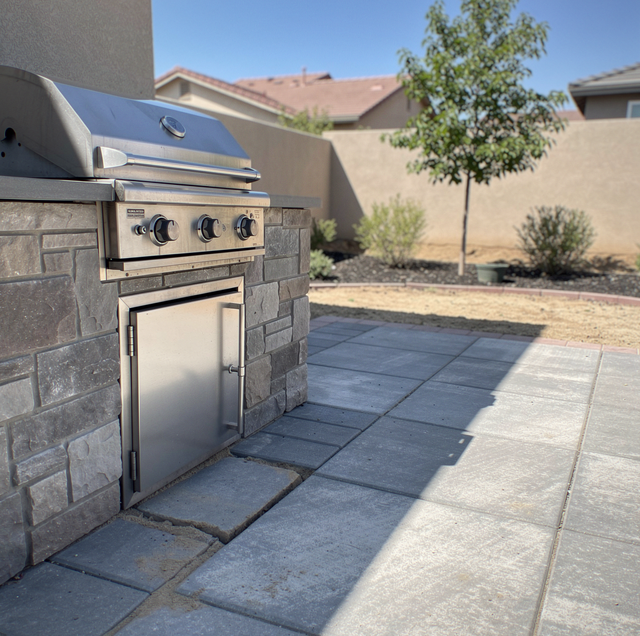
A built-in island and a prefab one can look nearly identical in photos: the same stainless doors, the same grill head, the same stone or tile front. What decides which one is still square and solid years later sits underneath and behind that finish, not on it. Three things settle the comparison: what the island sits on, what its shell is made from, and what happens to water that finds its way behind the surface. Get those three right, and either style can hold its shape outdoors. Get them wrong, and the finish is the first thing to show it.
The table below presents the two builds side by side before getting into why each one fails as it does.
| Build | What it sits on | Shell material | Where trouble starts |
|---|---|---|---|
| Masonry built-in | A poured concrete footing under the full footprint | CMU block core, veneer or stucco face on a mortar bed | A hairline crack at a mortar joint if the face loses its drainage path |
| Prefab or panel | Pavers or a thin surface slab, no dedicated footing | Powder-coated steel frame, thin adhered veneer or polymer panels | Rust at a fastener or seam, veneer cracking at a corner or cutout |
The Base Decides Everything Above It
A masonry island starts with a footing: a continuous slab of reinforced concrete poured under the entire island footprint before a single block goes down. Because the footing is one pour, every course above it moves together if the ground under it shifts at all. A panel island skips that step. It sits on pavers or on a thin surface slab built for foot traffic, not for carrying a loaded cabinet with a grill head and a stone countertop bolted to the top. The steel frame has no footing of its own; it rides on whatever the paver bedding does. When sand joints settle, or a paver edge drops a fraction of an inch, the frame racks slightly at that corner while the rest of the island stays put, and that twisting is where cracked veneer and rusted seams on a panel island start.
How Prefab Panels Fail Outdoors
Powder coating on a steel frame is a thin finish, and it is thinnest exactly where the frame was cut, drilled, or welded to assemble the cabinet. Moisture reaches bare metal first at those fastener points and at the seams where one panel bolts to the next, and rust starts there before it shows up on a flat face. A stone-look veneer panel is a thin layer, polymer or cement-based, adhered to a foam or cement-board backer and fastened to the steel frame. When the frame underneath flexes, even slightly, the veneer cracks at its weakest points first: a corner, an appliance cutout, or a seam between two panels, rather than across an open flat section. The cavity behind a sealed panel face has nowhere for water to go once it gets in. Foam backer does not drain the way an open mortar joint does, so moisture that works past a hairline crack sits against the steel frame instead of weeping back out. Sun works on a panel island at the same time: powder coat and printed polymer stone faces chalk and lose color on the sides that take the most direct sun, while mortar-set stone and integral-color stucco carry their color through the material.
What a Masonry Shell Does Differently
A CMU block core has its cells filled with grout and vertical reinforcement, which gives the wall itself structural strength independent of whatever finish is applied to the face. Stone veneer or stucco over that core is set on a mortar bed or held by mechanical lath, not glued to a foam backer, and a properly built face has a drainage plane and a weep path at the base course. Water that gets behind the finish has somewhere to go instead of pooling against the block. A stucco crack on a well-built shell tends to follow the mortar joint pattern underneath it rather than opening at a random stress point.
Appliances, Doors and Venting on Either Style
Grill heads come in two basic configurations: a drop-in insert that relies on the cabinet below it for airflow, and a fully insulated jacket unit that carries its own heat shielding. A drop-in head needs clearance on the sides and a vent cutout so that heat and any unburned gas have somewhere to go rather than building up in a closed box beneath the cooking surface. An insulated jacket grill can sit closer to the cabinet sides because the jacket does that job itself, but it still needs a rear vent path. Access doors and drawers vary: the gauge and grade of stainless behind a mirror-polished face changes how long it resists corrosion, and a door that looks identical to another one in a showroom can behave very differently after a season outdoors.
Running or modifying a gas line into an outdoor kitchen island is not a do-it-yourself job. Have a qualified gas fitter size and pressure-test the line before connecting a grill head or burner, for either build style.
Countertop overhang matters on both styles for the same reason, even though the countertop itself sits above the question of base and shell. A slab that drips straight down the front face instead of out past a drip edge keeps that water in contact with the finish underneath every time it rains or the island gets hosed down, which is exactly the kind of repeated wetting that works a hairline crack open or starts a rust streak under a seam faster than a dry season ever would.
What to Check Before You Commit
On a masonry build, ask whether the footing runs continuously under the full island or only under isolated points, and look for a weep screed or drainage detail where the veneer meets the base course. On a prefab or panel unit, check what it is set on: pavers alone, a thin slab, or an actual footing poured for it. Look for gaps between panels that widen toward one end, which can mean the frame has started to rack. Press on a stone-look face near a corner; a solid masonry veneer will not flex, while a thin adhered panel often gives slightly under hand pressure. Open an access door and look at the screw heads holding on hinges and hardware for early rust streaks, which show up well before a hole does.
Upkeep Each Style Needs
A masonry shell needs its stone or tile sealer refreshed on a schedule, and its weep holes or drainage gaps kept clear of mulch, dirt, and spider webs so they can still do their job. Hairline cracks at corners are worth checking each season, since a crack that was cosmetic last year can start carrying water this year if it widens even slightly. A prefab or panel island needs its fasteners and seams checked for surface rust at the change of seasons, before a small rust spot turns into a hole at a weld or fastener point. Keeping the paver joints under it swept and sanded matters, since a shifting base is where frame movement starts. In either style, the caulk or sealant line where a countertop meets a backsplash, or where appliance trim meets the surrounding shell, is worth a look every season: a joint that has opened even a sliver is the fastest path water can take into a cavity that otherwise has none.
Either style can carry a grill head, a sink and a stretch of counter for years without trouble. What separates the island still standing square from the one cracking at a seam is rarely the material named on the spec sheet. It comes down to whether the base underneath it and the cavity behind its face were built to shed water rather than trap it.
Frequently Asked Questions
304 stainless resists outdoor rust considerably longer than 430 grade, which carries less chromium and tends to surface-rust first at hinges and screw heads. A simple field check is a magnet: 430 is strongly magnetic, while 304 is close to non-magnetic, so a magnet that grabs hard on a door panel is a sign of the lower grade.
Inside the island behind an access door, where it can be reached and turned off without lifting out the grill head. The gas fitter sets the valve there before the shell is closed up; a shutoff buried behind block, veneer, or stucco has to be cut out the day someone needs it.
Leaked gas has to leave the cabinet, and which way it goes depends on the fuel: propane is heavier than air and settles on the cabinet floor, while natural gas is lighter and collects up under the grill. Vents both low and high on the island let either one escape, which is why a cabinet with only a top vent can still hold propane.
If the steel frame has not rusted through at the base rails, the cabinet modules can often be unbolted from their current pad and reset onto a newly poured footing without replacing the frame itself. The veneer panels usually have to come off first, since they are built to be installed once and are not designed to be pried off and reused.
Tap it. Real stone and a thick mortar-set stone veneer sound dense and dull under a knuckle, while a thin polymer or cement panel over a foam backer sounds hollow. Checking a loose or cut edge tells the same story: a true stone veneer shows stone through its thickness, while a panel shows foam or backer board under a thin painted or textured face.
Mismatched fasteners cause galvanic corrosion: a plain steel screw holding a stainless panel reacts with the surrounding metal when moisture is present, and the rust travels down from the screw head rather than starting from a flaw in the panel itself. Swapping to a stainless or coated fastener at that point stops the streak from spreading further.
Have your outdoor kitchen plans reviewed before the shell goes up — get a clear read on footing, base and shell before committing to either style. Specialty Landscape Inc. serves Fresno and the Central Valley. Licensed C-27 Contractor, CSLB #1058363. Call (559) 905-2273.


