





Is a Leaning Tree Dangerous? The Signs a Lean Is New
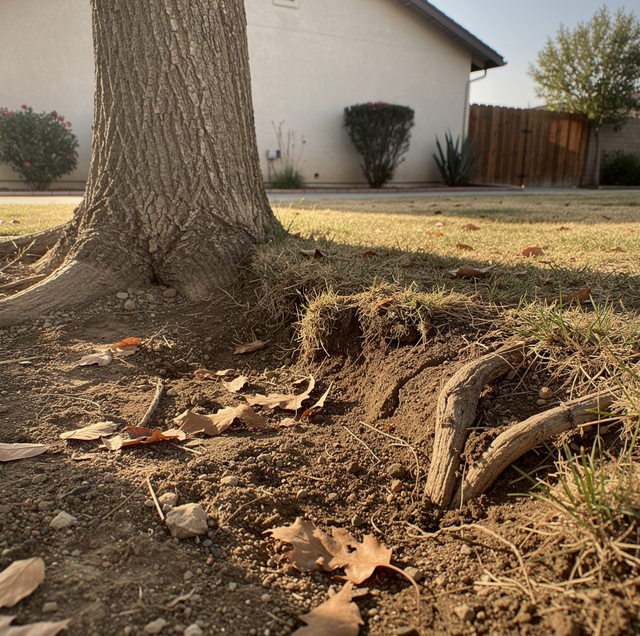
A leaning tree is dangerous when the lean is new or growing, or when the base has started to rot: soil lifting on the far side of the trunk, roots tearing up out of the ground, or fresh cracks at the base. A tree that grew into its lean over decades, with firm soil around it and a trunk that curves back toward vertical higher up, can stay where it is as long as nothing below it changes. The difference comes down to what the roots are doing, and the evidence is visible at ground level, where you can read it without climbing anything or using a saw.
How a Tree Grows Into a Lean and Stays Put
Trees bend toward open sky. One planted beside a two-story wall or under a neighbor's canopy shifts its crown toward the light year after year, and the trunk follows. While that happens, the tree lays down reaction wood to support itself. Broadleaf trees build tension wood on the upper side of the lean, which pulls the trunk upward; conifers build compression wood on the lower side, which pushes it. The roots grow to match the load too, thickening where they resist tipping.
The result is a tree anchored for the angle it carries. Signs of a settled lean:
- The trunk sweeps back toward vertical in its upper half.
- The crown sits roughly over the root zone instead of hanging past it.
- The soil around the base is flat, firm and unbroken on every side.
- Old photos show the same angle against the house or the fence line.
A lean you can find in pictures from ten years ago, with none of the warning signs in the next section, is the shape the tree grew into. It still deserves a look after storms, but it is no reason on its own to clear the yard.
Signs a Lean Is New or Getting Worse
A new lean that starts at the ground means the root plate (the disk of roots and soil under the trunk) has started to rotate; one that starts higher shows as cracking or buckling in the trunk itself. As the root plate turns, the roots on the side away from the lean get pulled upward, and the ground shows the movement before the canopy does.
Heaving soil: A raised mound or a ridge of lifted turf on the side opposite the lean, sometimes with a crescent-shaped crack running partway around the trunk. That is the root plate hinging up out of the ground.
Exposed or snapped roots: Roots that were buried last month and now sit above the soil, or roots with torn, fibrous ends showing on the high side.
Cracks at the root flare: The flare is where the trunk widens into its main roots. A vertical split there, or a gap opening between the trunk and the soil on one side, points to roots or wood giving way at the base.
Bark changes along the trunk: Bark that is wrinkled or buckled on the underside of the lean, or that shows a fresh split on the upper side, indicates the wood itself is straining.
A changed view: The tree now touches a roofline, wire, or fence it used to clear, or a gap has opened between the trunk and a nearby wall.
Any one of these on a tree tall enough to reach something you care about puts it in keep-clear territory. Two together, or any of them appearing right after a storm, describe a tree that may be moving now.
Causes Behind a Sudden Lean
Wind loads the crown, and the crown loads the roots. A gust a tree has shrugged off for years can tip it once something underground has weakened, which is why a new lean is worth tracing back to its cause.
Soft, saturated soil: Wet soil loses its grip on roots. A long soak from rain, a broken irrigation line, or a sprinkler zone aimed at the trunk can leave the root plate sitting in mud when the wind arrives. The opposite extreme matters as well: soil that has dried hard and pulled away from roots can leave voids that let the plate shift.
Cut roots: The bulk of a tree's roots is in the top 2 feet of soil and extends beyond the edge of the canopy. A trench for a drain line, a new slab, or a row of fence footings on one side can sever the roots that were holding against the lean. If anyone dug near the tree in the last season or two, suspect that first.
Root and base decay: Rot in the main roots or the lower trunk can leave a tree standing on less sound wood than it appears to have. Decay does not always show above ground until the tree starts to move.
Girdling roots: A root that circles the trunk at or just under the soil line can choke the flare and leave the tree poorly anchored on one side. Trees planted too deep, with the flare buried, are prone to them.
Lost neighbors: When a tree beside it comes out, a tree that grew up sheltered suddenly takes wind from a new direction, on roots that never had to brace for it.
Keep People Clear, Then Make the Call
If you find heaving soil, torn roots or new cracks at the flare, work through these steps in order:
- Move people, pets and parked cars out of the area the tree could reach if it fell the way it leans, plus a wide margin on both sides.
- Shut off any sprinkler zone that wets the ground around the tree, and hold off on watering it.
- Take photos from the side, outside the tree's reach, never from underneath it.
- Call a tree crew and describe what changed and when: the direction of the lean, anything in its path, and whether it moved after rain or wind.
The work itself, whether that means lightening the crown or taking the tree down, belongs to a rigging crew. A leaning tree carries its load unevenly, and a cut on the wrong side can let the trunk split upward or drop in a direction nobody planned.
Never cut roots, limbs, or the trunk of a tipping tree, and never rope it to a vehicle to pull it back. A leaning trunk stores tension that can release at once; leave every cut and line to the tree crew.
Can a Leaning Tree Stay, or Does It Have to Come Down?
There are three realistic outcomes, and the ground and trunk signs decide which one fits.
It stays as it is: A long-standing lean, firm soil, a sound flare, and nothing valuable in the path. The tree keeps its place and gets watched.
It stays with less weight: Where the roots are holding but the crown is heavy on the leaning side, reduction pruning shortens the longest limbs back to healthy side branches. Shorter limbs put less turning force on the root plate. The cuts matter: topping leaves stubs that throw fast, weakly attached sprouts, which put weight right back where it was.
It comes down: A tree with a lifting root plate, a cracked base or decay at the flare, aimed at a house, driveway or play area, is a removal. Near structures, that means taking it apart in sections and lowering each piece on ropes so nothing drops onto a roof or fence. The stump can then be ground below grade so the spot can be replanted, ideally with a tree that has open sky above it.
Watching a Lean That Seems Stable
A settled lean still deserves a walk-around after every big wind or long soak. Circle the base and look for the same signals: a mound on the far side, new cracks in the soil, roots that were not visible before. Then look up. A crown thinning on one side, or dead limbs gathering on the leaning side, can mean the roots underneath are struggling, though drought and pests produce the same picture.
Pick a fixed spot, such as a fence post or a paint mark on the driveway, and photograph the trunk from there every few months. Lining the trunk up against a vertical edge, like a downspout, makes new tilt easy to spot.
Protect the roots that are doing the work. Keep trenching, new paving and heavy equipment away from the soil under the canopy, aim sprinklers away from the trunk, and never pile soil or mulch up against the flare, where it can hold moisture against the bark.
A lean tells you how a tree grew. The ground around the trunk tells you what it is doing now. Read the soil first, and when the soil has moved, put distance between people and the tree before anything else.
Frequently Asked Questions
Only a young one. A recently planted tree that tipped in soft soil can be set straight and staked with loose, flexible ties that still let the trunk sway a little, and the stakes come off after one growing season so the trunk builds its own strength. An established tree cannot be winched back, because the roots that would have to bend are the ones already failing.
Treat at least one and a half times the tree's height as the danger zone, so 60 feet for a 40-foot tree. A falling trunk can slide or bounce once it lands, and limbs snap off and carry past the point where the top hits the ground.
No. Pruning lowers the load, but it does not move the trunk. Any single pruning should take no more than about a quarter of the live crown in one season; stripping more forces a flush of weak growth and cuts the leaf area that feeds roots already under strain.
Yes. Mushrooms or shelf-like conks growing on the buttress roots or the bottom of the trunk are a sign of wood decay inside the roots or base, and a conk can mark decay that has been spreading inside for years before anything showed outside. Mushrooms coming up in a lawn several feet from the trunk are not, on their own, proof that the tree is rotting.
Assume the wire is live and the tree is too. Keep people and tools at least 10 feet from the wire, call 911 if anything is sparking or on the ground, and report it to the utility, since any work at the line is theirs to do.
Partly. A palm has no taproot; it anchors on hundreds of small roots growing from a band at the base of the trunk called the root initiation zone. A cluster of visible roots at the foot of a palm is normal; judge a leaning palm by heaving the soil and a tilting root ball, not by exposed roots alone.
Get a crew out as soon as the soil at the base moves — a leaning tree can be lightened or roped down in sections before it shifts any further. Specialty Landscape Inc. serves Fresno and the Central Valley. Licensed C-27 Contractor, CSLB #1058363. Call (559) 905-2273.


