





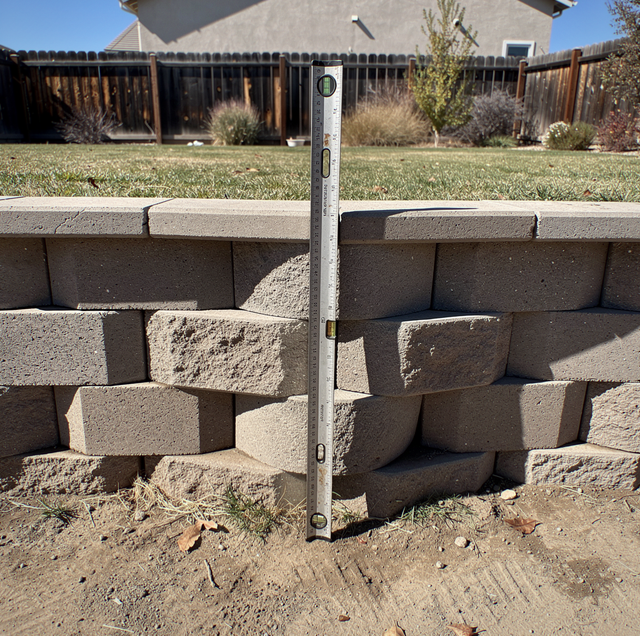
You are walking the back of the yard, and the cap on the retaining wall no longer runs in a straight line. Halfway along, the face pushes out toward the lawn, the fence on top tips forward with it, and a level pressed to the block touches at the top and stands off the wall at the bottom.
A lean or a bulge means the soil behind the wall is pushing harder than the wall, its footing and its reinforcement can resist. The extra push can come from water trapped in the backfill with no gravel or drain to release it, a footing too shallow or narrow to hold the base, clay that swells against the wall each time it gets wet, or added weight near the top, and one wall can suffer from several at once. Some leans settle and hold for years; others keep moving, and those need a different response.
How a Retaining Wall Holds Back Soil and Water
Soil on the high side presses sideways against the back of the wall, and that pressure increases with depth, so the heaviest load sits near the base. A wall resists with its own weight, a footing that keeps the base from sliding or tipping, and on taller block walls, steel bars set in grout-filled cells so the courses act as one unit. Segmental block and dry-laid stone walls are also built with a slight backward tilt, each course set back from the one under it. A segmental wall built with that setback, which now stands plumb, has already moved.
Water adds a second load. Saturated backfill carries the pressure of the water in its pores, and that water pushes in all directions, including straight outward against the wall. A wall built to last gives it a way out: a zone of clean gravel against the back face, a perforated drain pipe along the base, and outlets that let the water leave. When native soil is packed straight against the block, the water stays put, and the wall carries the full load.
Why the Bulge Shows Up in the Middle
A bulge partway along a run tells you where the wall is held and where it is not. The ends are stiffened by corners, returns that turn back into the slope, steps, or a tie into a block fence or the house. The middle span has none of that, so when pressure builds, the center moves first, and the face bows out between the stiff ends.
On a segmental wall without reinforcement, the bow can also sit at mid-height. The base course is buried and pinned by the soil in front of it, and the cap row carries little load. The units in between have the least restraint and a heavy load behind them, so they can creep forward one course at a time.
A mortared or grouted block wall cracks first, forming horizontal lines along a bed joint or a stair-step pattern that follows the mortar around each block, and the bowed area sits within those cracks. A wall that tilts as a single plane from end to end, with no bow, points toward a separate problem: the whole wall rotating on its footing.
Trapped Water Behind a Wall With No Gravel or Drain
The block or stone stays dark for days after rain; water seeps through joints near the base; the soil at the foot of the wall stays soft; and moss or green algae can grow on the lower courses. A telling combination is wet backfill with dry outlets: the soil behind the wall is soaked, yet nothing runs out during a hard storm.
Check what feeds the backfill: spray heads watering a lawn on the high side, roof water reaching the top of the slope, or a patio that sheds rain toward the wall. Shutting off a sprinkler zone that wets the strip behind the wall lowers the load while you work out what comes next.
A Footing Too Shallow or Too Narrow
The footing spreads the wall's weight over enough soil to support it and prevents the base from kicking out. When it is shallow or narrow, or when the first course sits on a skim of gravel over loose fill, soil pressure tips the wall forward around its front edge, called the toe.
Watch where the movement concentrates. A bottom course shoved forward past a patio edge or a line of posts it used to match points to the base sliding or settling. A lean that grows toward the top over a straight base points to the wall rotating. Wet soil under the toe carries less load, so poor drainage strains the footing right when the backfill is heaviest.
A parked car, a shed, pallets of pavers, or a spa near the top adds load to the backfill, which passes much of it sideways onto the wall.
Clay That Swells Wet and Shrinks Dry
On heavy clay, the soil itself moves. Clay takes up water and swells, pressing against the wall harder than it did when dry. As it dries, it shrinks and pulls away, opening a gap behind the wall into which loose soil and debris fall. When the next wet season comes, the clay swells against a gap that is no longer empty and pushes the wall a little farther. Where there is no drainage, swelling and trapped water stack on top of each other, so a lean that worsens each winter and holds steady through a dry summer fits this pattern.
Sandy ground behaves differently. Water drains through it quickly, and the soil does not swell, so a lean on sandy ground points first toward the footing, poorly compacted backfill, a missing setback, or extra weight near the top.
Measure the Lean, Then Watch It
A single reading shows where the wall is; repeated readings show whether it is moving. Hold a 4-foot level upright against the face at a few spots, note where it touches, and measure the gap at the other end. Mark each spot with pencil or paint so you return to the same place, and photograph each mark with a tape measure in the frame. Recheck after each soaking rain and every few weeks between. The table below pairs what you see with what it tends to mean.
| What you see | What it points to |
|---|---|
| Face bows out in the middle of the run, ends straight | Pressure behind an unreinforced span: trapped water, swelling clay or both |
| Whole wall tilted as one plane | Wall rotating on a footing too small for the load |
| Base course pushed out past where it started | Base sliding on wet or loose soil |
| Horizontal or stair-step cracks in mortar joints | Block wall bending under the load behind it |
| Damp face, soft soil at the toe, dry drain outlets | Water held in the backfill with no way out |
| Soil cracking or sinking just behind the cap | Backfill moving forward with the wall |
For a long wall, drive a stake past each end, stretch a mason's line between them a few inches off the face, and measure from line to wall every few feet. Repeat from the same stakes after heavy rain.
When a Lean Is a Stop-and-Call Sign
Treat any of these as a sign the wall needs an assessment before the next storm:
- Movement between checks: The gap at your level or line grows from one reading to the next.
- New or widening cracks after rain: Fresh cracks in the joints, or old ones opening further.
- Loose or dropping units: Blocks or stones shifting out of the face, or caps sliding off.
- Soil washing out: Dirt spilling from the joints or from under the base course.
- A crack in the ground behind the top: A line in the soil running parallel to the wall can mean the backfill is moving with it.
- What the wall holds up or faces: A driveway, a slab, a patio or a neighbor's yard on the high side, or a walkway, play area or the house within reach of a falling wall.
While you wait, take the load off the wall. Move parked cars, stored materials and firewood back from the top, shut off irrigation that wets the backfill, and keep people and pets off the top and out of the strip in front. Do not dig at the foot of the wall, since that soil helps hold the base in place.
Do not try to jack, brace, or pull a moving wall back yourself, and do not dig behind it to relieve pressure. A loaded wall can drop without warning; have a masonry crew assess it and set any temporary support.
Repairing a Moving Wall or Rebuilding It
A wall that leaned because water had no way out does not move back once the water drains. If the lean is small, has held steady through a wet season, and the cause is surface water, cutting off that water can slow further movement. Adding a real drain is a different matter: the pipe belongs at the bottom of the backfill, so reaching it means excavating behind the wall, which on a leaning block or stone wall can mean taking it down.
A wall that keeps moving is taken down to the course where the movement starts and rebuilt there. That means digging out the backfill, correcting the footing, setting a gravel drainage zone and a perforated pipe behind the new courses, and adding reinforcement for the height: steel and grout in block cells, or layers of reinforcing grid laid back into the soil on a segmental wall. The backfill goes back in thin compacted layers. Patching cracks without fixing what pushed the wall leaves the same load in place.
A retaining wall shows you its problem in the shape of its movement: a bow between stiff ends, a tilt from the base, a step with each wet season. Read that shape, measure it, and keep weight and water off the wall, and you will know whether you are watching a settled lean or one that needs a call before the next storm.
Frequently Asked Questions
Not in a way that lasts. Once the wall moves, soil slumps into the space behind it, so pushing the face back compresses that soil and leaves the original cause untouched. Straightening is done by taking the wall down and relaying it. On a natural stone wall, each stone is numbered or photographed as it is removed so it can be returned to the same position.
A drain can clog slowly. Without filter fabric between the native soil and the gravel, fine silt washes into the gravel and the perforated pipe over several years until water no longer reaches the outlets. A change uphill can also start it: a new lawn, a planting bed, or a patio that sends more water into the backfill than the wall ever handled.
No. Thin vertical cracks at regular spacing in a concrete or grouted wall can be shrinkage, and some walls have control joints cut in on purpose. The cracks to watch are ones where the two sides no longer line up. Lay a straightedge across the crack: if one side stands proud of the other, the wall has moved along that line.
They can. Roots grow toward the damp gravel behind a wall and can enter the slots of a perforated drain pipe, filling it and shutting off drainage. A large tree close to the top also adds its weight to the backfill and rocks in the wind, working the soil it stands in against the wall.
Water alone exerts about 62 pounds per square foot for every foot of depth, so at 4 feet down it presses roughly 250 pounds per square foot on the wall's back face. That load comes on top of the weight of the soil itself, which is why a full, undrained backfill can move a wall that held fine through dry seasons.
Partly. Its open joints let water pass through, so trapped water builds less pressure behind it than behind a mortared wall. A dry-stacked wall depends on its width, its backward tilt, and through-stones, the long stones laid front to back that tie the face into the core. Where through-stones are missing, or the base sits on topsoil, stones creep out one at a time.
Schedule a free on-site look at your wall — find out whether trapped water, the footing, or swelling clay is moving it, and whether it needs drainage work or a rebuild. Specialty Landscape Inc. serves Fresno and the Central Valley. Licensed C-27 Contractor, CSLB #1058363. Call (559) 905-2273.

